Patch Notes: Tallest Cliff in the Solar System
Today, we have something interesting: the tallest cliff in the solar system.
Miranda is the smallest "major" moon of Uranus (aka, round under its own gravity and not just a captured lump of rock), and one of the smallest bodies in the solar system to collapse and become spherical under its own weight.
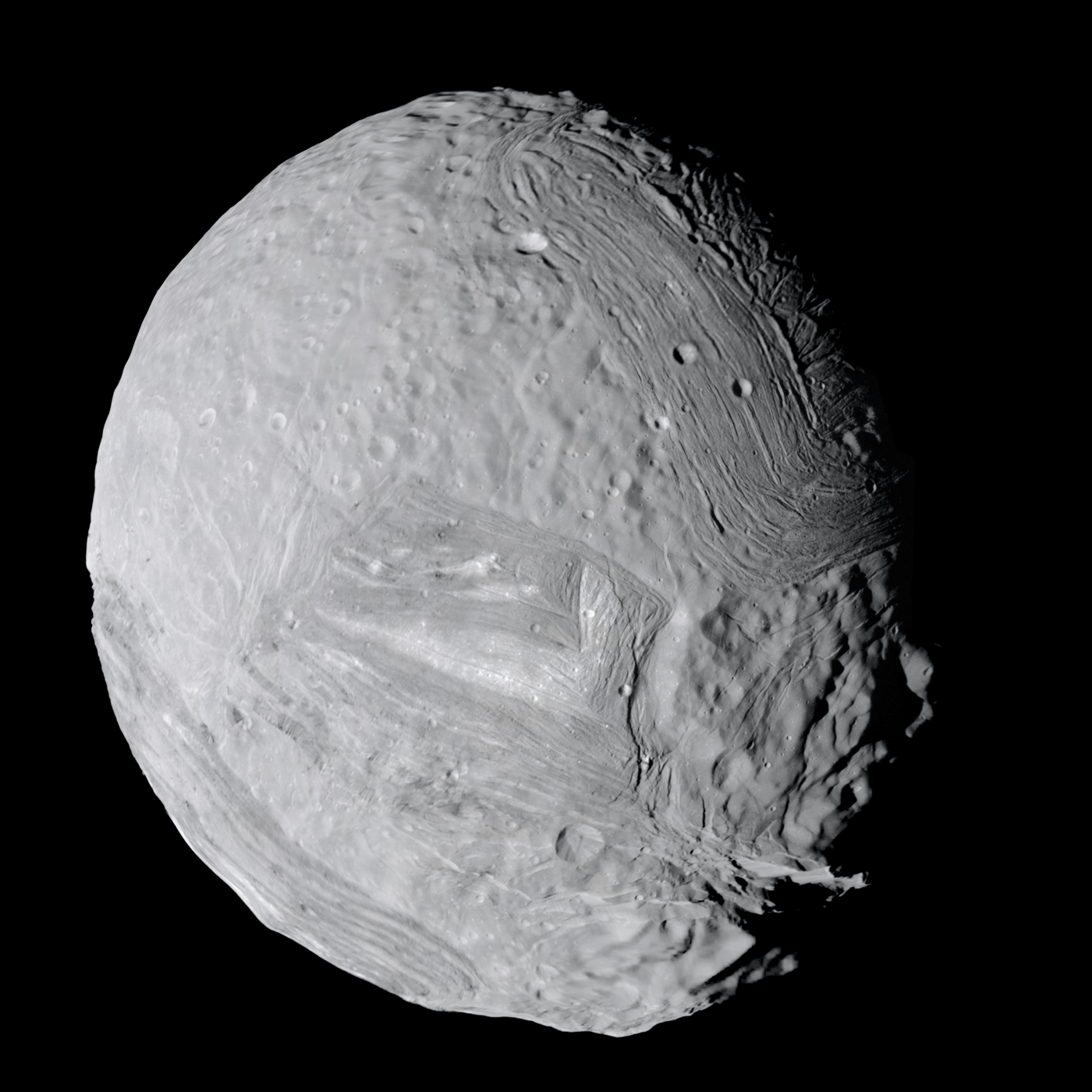
Miranda is a strange and beautiful little creature, only caught in a glimpse by the second Voyager probe, from which the above composite was assembled. It has about the same surface area as Texas; a big place to live, but tiny for a moon.
Though it seems to be made of about 60% water ice, Miranda is still far more rocky than most outer moons, and has a far stranger and more active tectonic history. No one knows exactly why that is; it's much too small to retain heat on geologic timescales, and the orbit of Uranus is a very cold place.
And yet, Miranda has an incredibly diverse surface that hints at a hot past. It is possible that it is filled with a greater than normal number of radioactive isotopes, which bled into its rock and created heat. However, current scientific thinking points to a gravitational dance with its sibling moon Umbriel. Close interactions between astronomical bodies can cause the smaller one to stretch and contract with every orbit (as our own liquid oceans do in response to the moon). When this happens to rock, the friction generates heat, which builds up and can melt entire portions of a planet's inner mantle. This is the origin of the volcanoes on Io, our solar system's most geologically active body.
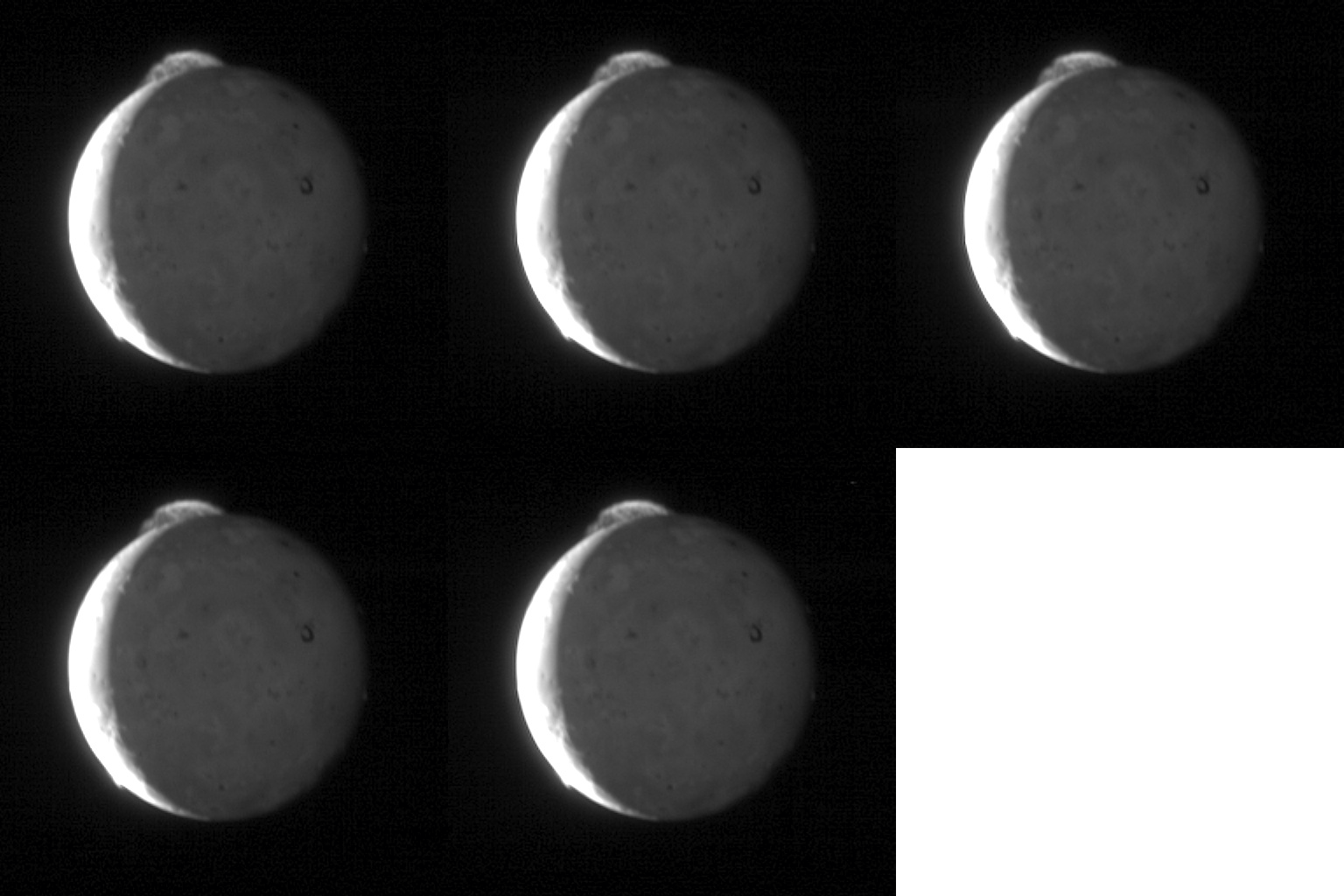
Whatever the case, Miranda is highly differentiated, which means it likely has a thick ice shell encasing the entire planet, and possibly a liquid water ocean with a stone and carbon ocean floor.
At Uranic temperatures, ice is harder than granite is here on Earth. And it forms some of the most striking surface features of any body in our solar system: canyons, chasms, craters, boulder fields, gravel pits, and the largest cliffs humanity has ever pointed a camera at.
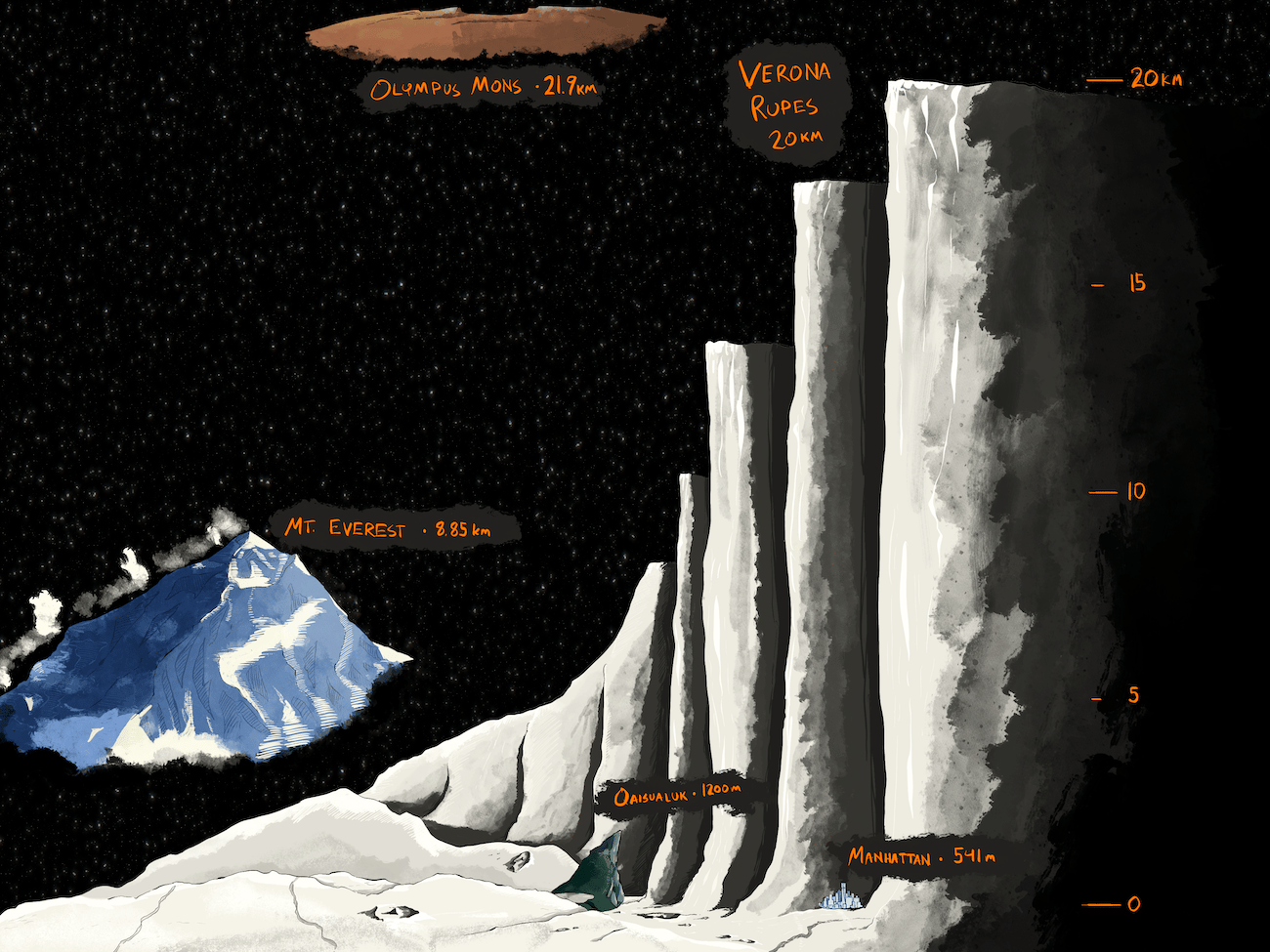
This is Verona Rupes, the tallest known cliff in the entire solar system. It is 20 kilometers in height1, and at least a hundred kilometers in length -- no one is exactly sure how long it actually is, because we only have the one flyby (Voyager 2 in 1986) to work with, and it was only able to take photos of one side of the moon.
That height puts it just under the height of the tallest mountain in the solar system (Olympus Mons on Mars, at 21.9km), and over twice the total height of Everest on Earth (8.85 km). In fact, if you measure Everest from its "base" on the Tibetan massif (which is ~4km above sea level, making Everest almost 5km in "actual" height), Verona Rupes is four times its elevation.
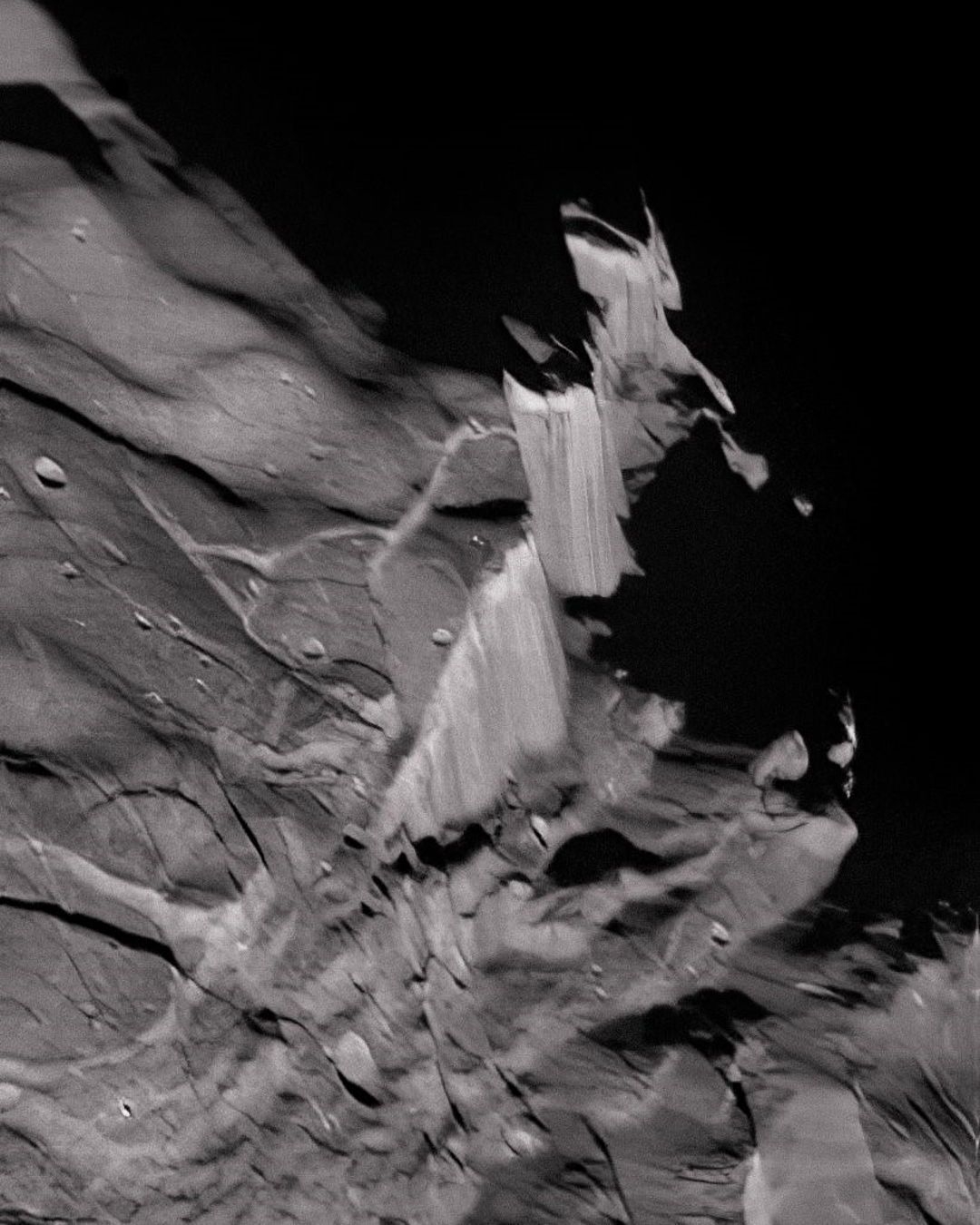
It is over sixteen times the height of the tallest cliff on Earth -- Qaisualuk on Baffin Island in Canada, which has a vertical drop of over 1200 meters. Were you to drop a large stone off of the top of that cliff, it would take more than fifteen seconds to reach the ground, and would be going over 550 km per hour (over 340 mph) when it did. A human would take even longer, as they'd hit terminal velocity in atmosphere at around 200 km/h.
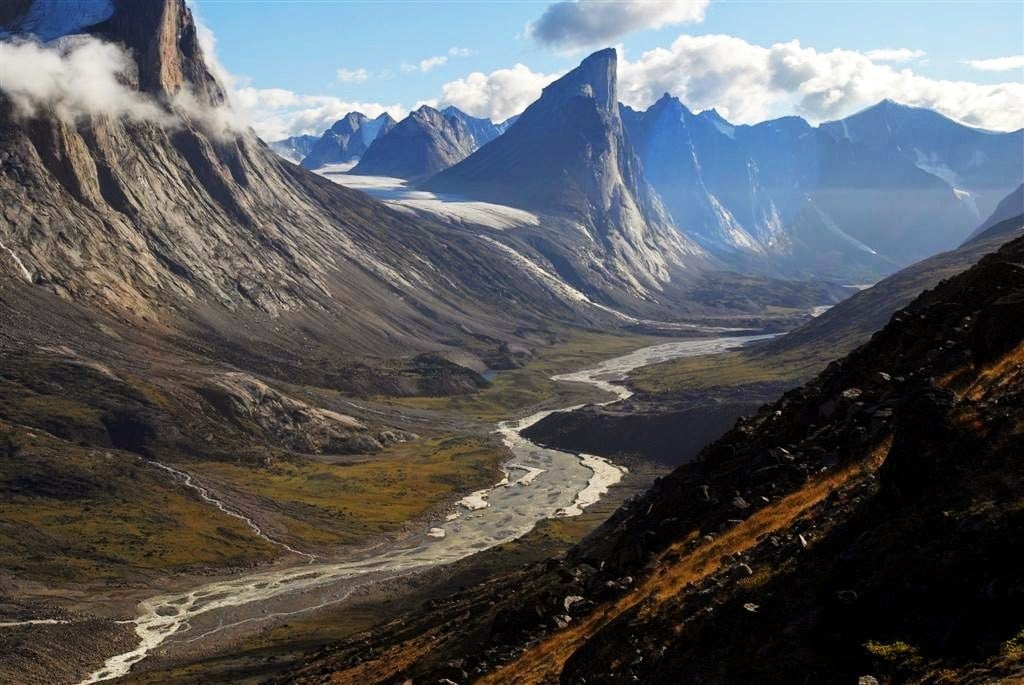
Either way, that would be a long time to regret not bringing that extra ice axe.
Miranda, conversely, only has 1% of Earth's gravity, which means that if you were unlucky enough to fall off the top of it, you'd have twelve minutes to regret the life choices that brought you there ... and then get bored with the mental conversation and wish you'd brought a book.
When you finally hit dirt (well, ice), you'd also be traveling about 200 km/h (124 mph) -- ironically, about the same speed you'd be falling from any great height here on earth due to atmospheric drag. Hopefully your space suit has airbags!
Who knows if we humans will ever figure out our shit and grow up enough to be trusted as guests of other worlds. But if we do, some truly astounding places await us.
Footnotes
-
reports differ on its height, but NASA itself uses the 20km figure, so that's what we're using here. ↩
The Changelog is published weekly. I do a monthly Feature on the last Friday of the month with an in-depth systems analysis of a social or political issue like the Israeli-Palestinian conflict or AI cults.
On all of the other Fridays, you get Patch Notes. Plant and animal facts, game mechanic analyses, digital and analog tools, and whatever else is interesting that week.
I will never advertise to you or sell your information to anyone.