Patch Notes: Embodiment + Witch Hazel
Hello everyone! Today we introduce a new patch notes section: "Pieces of Games", where we discuss elements of game design, how they can be used in art, and how they cross over to impact the rest of our lives (often without our knowing about it). We also discuss witch hazel, a tree that blooms in the winter, provides good medicine, and propagates its seeds through explosions.
New Section: Pieces of Games
As I talked about in the first Changelog, games are pieces of art that engage with the artistic medium of logical systems. That makes them interested in human systems in the same way novels are interested in human psychology and human relationships. And like any other kind of art, games have the potential to provide insight into these areas.
In my experience, the vast majority of games so far do this naively: a given game is much more likely to encode assumption than it is to cut through it. But the potential is there, and that makes the medium worth exploring in a deconstructive way.
As such, this new section will be cycling into the Patch Notes rotation, alongside Tools of the Week and Something Interesting. I hope you find it valuable, and please feel free to drop me a line on Bluesky or Mastodon with your thoughts!
Pieces of Games: Embodiment
Games are a strange combination of intentional interaction with logical systems and a kind of "playing pretend" -- an assumption of a role for the duration of the game. Designers often refer to this as the "magic circle"; your decision to accept the terms of the gameworld for the duration of play.
This is true of the games we use to operate our society as well -- the formal systems we have constructed in parliaments, courtrooms, and so on. Outside of the court, a judge, a bailiff and a couple of lawyers talk and interact like normal people in normal lives. Within the "magic circle" of a courtroom in session, each has a specific role to play, with specific actions available and unavailable, and outcomes that must be competed over within that ruleset. When court is in session, each player "steps into" their role, and remains there for the duration. This is embodiment.

In the more common sort of game, embodiment can be a more abstract inhabitation of a set of rules (chess, go, poker), where the role is more defined by our relationship with the other people playing: namely, that we want to defeat them, which hopefully is not something true of our normal lives outside of the magic circle! I suspect there is an entire sociological / evolutionary underpinning to this kind of play, where the magic circle provides us the space to practice conflict, aggression, subterfuge and so on, without it bleeding over into our normal lives outside of the game.
Embodiment can also be direct and intentional, especially when it comes to the much more experientially dense world of video games. Here, a player can inhabit a specific character, in a specific world. The purpose of this is often power fantasy: for an hour or two, a normal person can feel like they are a superhero, a warrior, a witcher, a detective, a mage. This is often where those assumptions we spoke about earlier come into play: the purpose of a fantasy is not to make a person feel like an actual warrior (traumatized, dissociated, hypervigilant); it is to make them feel like what they believe a warrior would feel like (powerful, attractive, agentic).
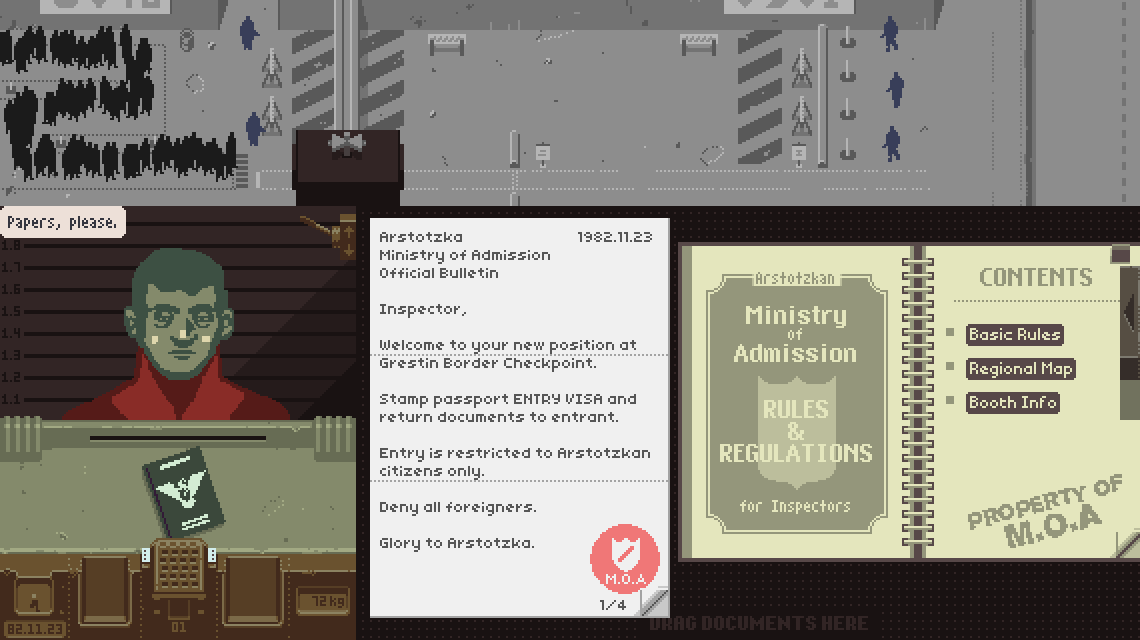
I believe there is great potential here. A few games have used embodiment to actual artistic effect: Papers, Please, for instance, puts the character in the body of a fictional Eastern bloc immigration inspector, faced with a number of bleak decisions: to enforce unjust border rules or face imprisonment, or to engage in corruption because you don't make enough money to provide food, heat, and medicine for your family.
There's a common belief that games can somehow be "empathy boxes" -- that to "play as" e.g. a homeless person or a victim of systemic abuse is to create empathy for them. This is not quite true. A novel is a much better vehicle for empathy directly, as it seats us in the experiences, feelings, and decisions of someone else.
What a game does is ask "what would you do in this situation?" And it is only effective if the game's creator has a deep understanding of the systemic forces at play against the character. Papers, Please doesn't show you what it feels like to work at a border crossing in a corrupt police state. What it does do is constrain your choices such that you have a sudden moment of clarity (satori) about why people in these situations make the choices they do.
It is my hope that, as our medium matures, game designers engage with embodiment more intentionally, and use it to explore the systems that make people make the choices we make, and by those choices shape the world.
Something Interesting: Witch Hazel
This week while reading Braiding Sweetgrass I learned for the first time about witch hazel.

Witch hazel is a magical plant that was used by the American peoples for countless generations before the arrival of Europeans. It could be used to treat all sorts of things: muscle aches, inflammation, poison ivy rashes, burns, insect bites, and more. The medicine lives in the bark and leaves; you can mash them with a mortar and pestle and boil or mix with water to make a poultice, or boil them to make a tea that helps with stomach aches, cold symptoms, and even dysentery (the Haudenosaunee people sweetened this tea with maple sugar).
The Potawatomi and Menominee peoples would put witch hazel twigs on heated stones before pouring water on them for sweat lodges; the steam had a potent restorative effect on the whole body, even helping with certain eye issues in some reported cases.
As with many such things, witch hazel's use was picked up by many poorer European immigrants and free Black communities all up and down the east coast, and is an important part of Appalachian and Low Country / Gullah herbal traditions today.

And if this weren't enough, it also blooms in late fall or even (for some varietals in the Ozarks) proper winter and early spring -- after the leaves have fallen, and often in the midst of frost and snow on the ground. The petals have evolved a special way of curling in order to protect themselves from nighttime temperatures and hard frosts, and can easily survive temperatures well below freezing. It shares a symbiotic relationship with the Eupsilia owlet moth, which is cold-weather adapted and active at around the same times -- when other flowers, and other pollinators, are all mostly dormant.
And when it reproduces, it does so with a bang; its seedpods literally explode, firing its seeds to a distance of up to 30 feet.
If you enjoyed this, consider subscribing! Changelog letters are delivered weekly on Friday. I will never advertise to you (unless I'm letting you know about something I personally made) or sell your information to anyone.